Filipino American History Month 2026
Beyond the Margins: Centering Intersectional Filipino American Histories
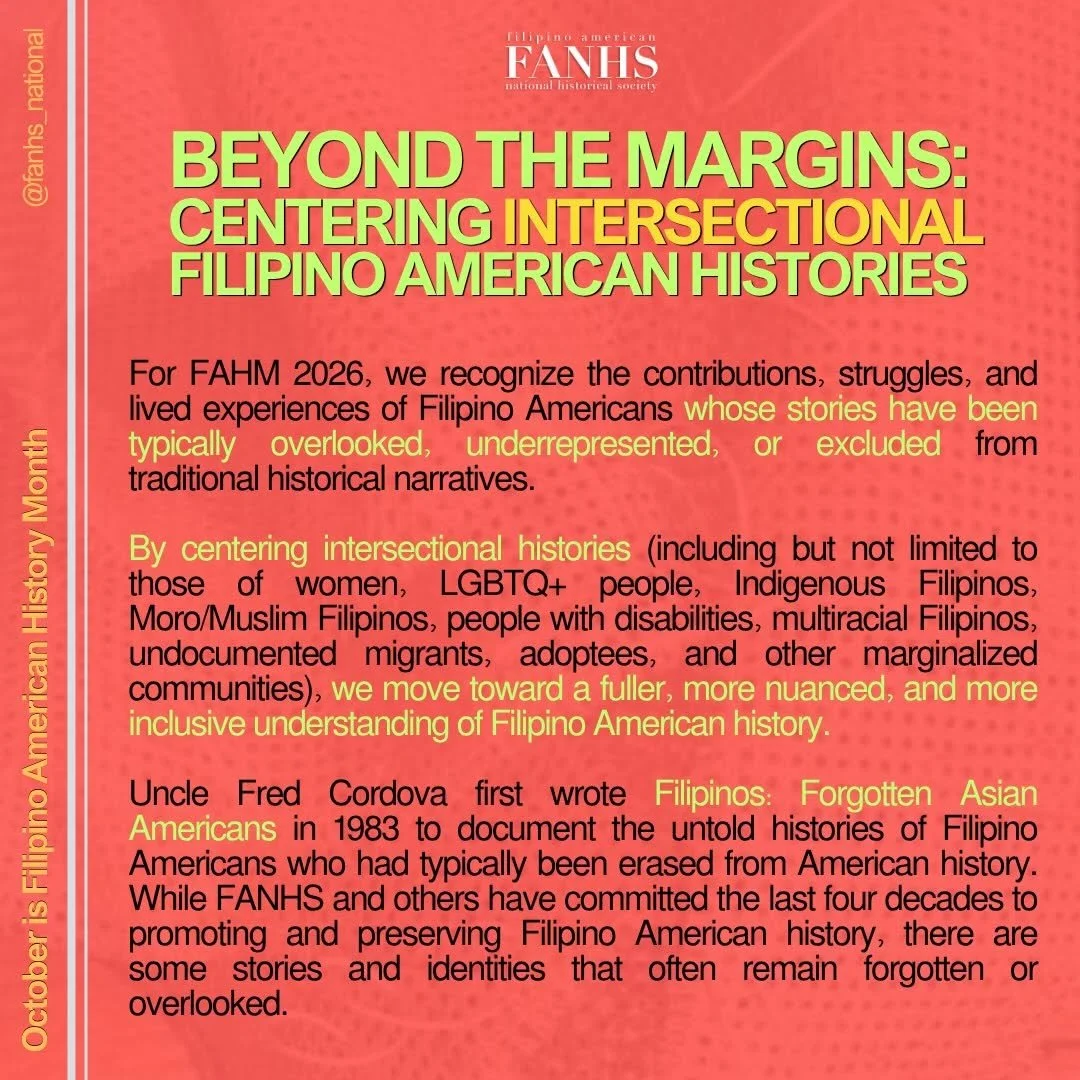
The theme for FAHM 2026 recognizes the contributions, struggles, and lived experiences of Filipino Americans whose stories have been typically overlooked, underrepresented, or excluded from traditional historical narratives. By centering intersectional histories (including but not limited to those of women, LGBTQ+ people, Indigenous Filipinos, Moro/Muslim Filipinos, people with disabilities, multiracial Filipinos, undocumented migrants, adoptees, and other marginalized communities), we move toward a fuller, more nuanced, and more inclusive understanding of Filipino American history.
Historical Context
Uncle Fred Cordova first wrote Filipinos: Forgotten Asian Americans in 1983 to document the untold histories of Filipino Americans who had typically been erased from American history. While FANHS and others have committed the last four decades to promoting and preserving Filipino American history, there are some stories and identities that often remain forgotten or overlooked. First, many historians have written about how Filipina women in the early 1900s were essential in building communities among the migrant workers in places like Stockton, Delano, Seattle, Hawai’i, and Alaska.1 Further, Filipino Americans have played vital roles in LGBTQ+ history, with examples including Rosemary Bamburger as the founder of the first known lesbian organization in the 1950s (The Daughters of Bilitis) and Richard Adams as part of one of the first same-sex couple to get legally married in the 1970s and the first same-sex couple to file the first lawsuit to seek recognition of a same-sex marriage by the federal government.2
Some aspects of Filipino American history overlook or erase the cultural identities of indigenous peoples from the Philippines. For instance, when discussing the Filipinos who were forced to participate at “human zoo” attractions in St. Louis and Coney Island in the early 1900s, the stories of actual indigenous people are either minimized, reduced to objects of colonial spectacle or tragedy, or erased altogether. For example, Antero Cabrera was a young orphan who was first recruited to participate in the St. Louis World’s Fair in 1904; traveled with many exhibits across the country; and later built a life and a family in the U.S. Relatedly, “Maura” was a teenage girl who died of pneumonia before the start of the St. Louis Fair in 1904; her remains were found among a “racial brain collection” at the Smithsonian, alongside the remains of many other indigenous Filipinos. While some community leaders have been able to identify some of the 1200 indigenous peoples who lived or died at the St. Louis World’s Fair,3 most remain unnamed and their histories remain untold.
A Push for Intersectionality
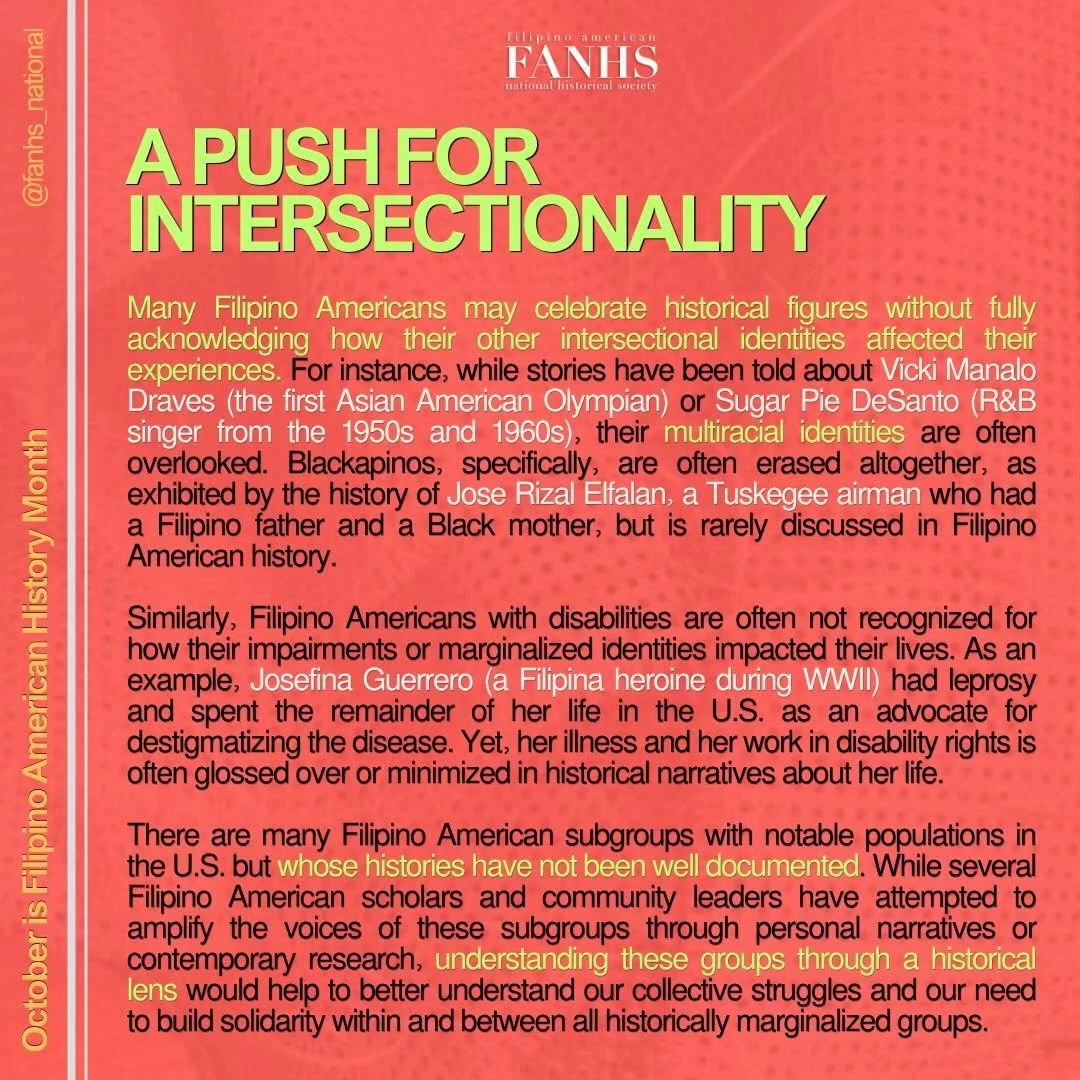
Many Filipino Americans may celebrate historical figures without fully acknowledging how their other intersectional identities affected their experiences. For instance, while stories have been told about Vicki Manalo Draves (the first Asian American Olympian) or Sugar Pie DeSanto (R&B singer from the 1950s and 1960s),4 their multiracial identities are often overlooked. Blackapinos, specifically, are often erased altogether, as exhibited by the history of Jose Rizal Elfalan, a Tuskegee airman who had a Filipino father and a Black mother,5 but is rarely discussed in Filipino American history. Similarly, Filipino Americans with disabilities are often not recognized for how their impairments or marginalized identities impacted their lives. As an example, Josefina Guerrero (a Filipina heroine during WWII) had leprosy and spent the remainder of her life in the U.S. as an advocate for destigmatizing the disease.4 Yet, her illness and her work in disability rights is often glossed over or minimized in historical narratives about her life.
There are many Filipino American subgroups with notable populations in the U.S. but whose histories have not been well documented.4 For example, there are sizable populations of Filipino Americans who are Muslim or Moro; adoptees; undocumented immigrants, transgender; people with disabilities; and more. While several Filipino American scholars and community leaders have attempted to amplify the voices of these subgroups through personal narratives or contemporary research, understanding these groups through a historical lens would help to better understand our collective struggles and our need to build solidarity within and between all historically marginalized groups.
A Call for Action
Celebrating subgroups that are typically overlooked is especially important during a time in which diversity, equity, and inclusion efforts are being erased. As government leaders threaten to flatten marginalized histories, choosing this theme allows FANHS to demonstrate the need to resist censorship; to advocate for social justice; and to offer a more comprehensive telling of our community’s existence and our rights to exist.
Further Readings
1. Mabalon, D. B. (2013). Little Manila is in the heart: The making of the Filipina/o American community in Stockton, California. Duke University Press.
2. Nadal, K. L. Y. (2023). Queering Filipino American History: Exploring LGBTQ+ Filipina/x/o American THEIR/OURstories. Filipino American National Historical Society Journal, 11(1), 81-110.
3. Langholz, Janna Añonuevo (2026). Philippine Village Historical Site. https://www.philippinevillagehistoricalsite.com/
4. Nadal, K. L., Tintiangco-Cubales, A., & David, E. J. R. (Eds.) (2022). Sage Encyclopedia of Filipina/x/o American Studies. Thousand Oaks, CA: Sage.
5. Cordova, D. L. (2009). Filipinos in Puget Sound. Arcadia Publishing.